Created by Konvert Media
Prompt
Subject
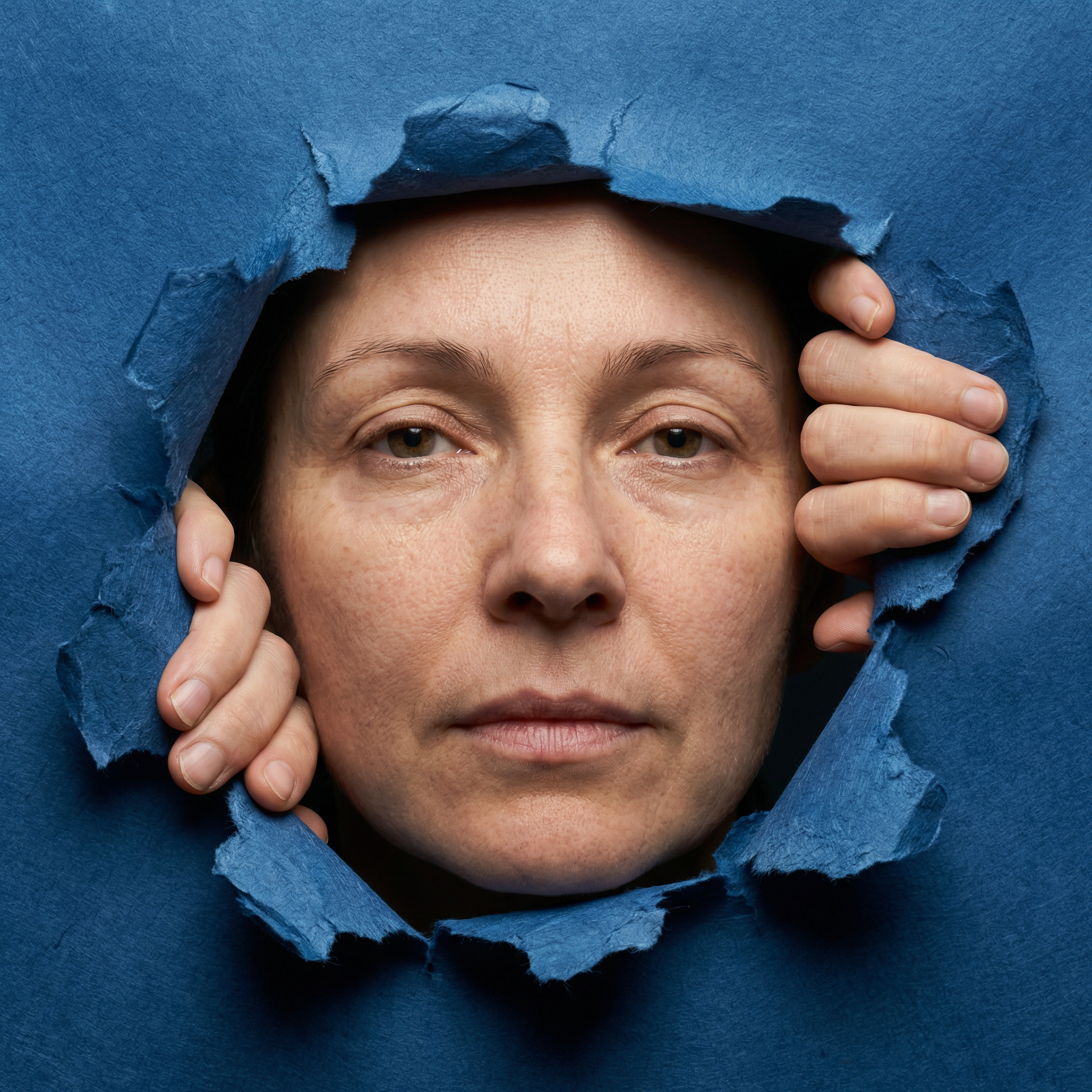
One adult woman, extreme close-up portrait with face occupying 75–80% of frame height. Natural facial geometry, proportions, and asymmetry preserved exactly as visible. Visible pores, uneven microrelief, micro-shadows, and authentic skin texture. No beautification, smoothing, or idealization. Neutral, controlled expression. Eyes gazing directly into lens. Head facing camera straight-on.
Scene
Woman's face framed through irregular, asymmetric tear in deep blue paper. Dark, undefined background behind subject. No text, graphics, or symbols. Paper held from behind by both hands gripping edges, fingers creating visible pressure deformations and inward bending of paper.
Composition
Vertical framing, extreme close-up. Camera at eye level, perpendicular to face, no tilt or rotation. Short telephoto compression (85–100mm equivalent) eliminating wide-angle distortion. Shallow depth of field maintaining focus on face and paper edges. Paper tear positioned as primary compositional element framing the subject.
Lighting
Single frontal light source positioned slightly above eye level. Soft but directional quality. Shadows form under brow ridge, nose, lower lip, and within paper layers. Neutral color temperature. No cinematic contrast shaping. Micro-shadows visible between paper layers and fibers.
Style
Photorealistic studio portrait. Conceptual surreal aesthetic. No poster aesthetics, no cinematic mood language, no stylization. Paper texture remains readable at close inspection. Fibers visible under light. No artificial grain, no HDR.
Color & Tone
Deep blue paper with color variation due to thickness and fiber density. Darker blue in folded and layered areas, lighter blue on exposed fiber tips. Neutral skin tones unaffected by paper color. No color grading or color bleed.
Camera
DSLR/Mirrorless full frame, 85–100mm equivalent telephoto lens, f/4–f/5.6 aperture, ISO 100–200, 1/125–1/250s shutter speed, shallow depth of field with critical focus on face and paper edges
Material / Physics
Thick, multi-layered fibrous paper with visible cellulose fibers at torn edges. Uneven fiber lengths protruding irregularly. Layer separation visible where paper has torn. Matte surface with micro-roughness, no glossy coating. Tears follow fiber direction with micro-fractures, feathering, and crushed fibers. No clean lines or symmetry. Paper bends inward under hand pressure with local creasing near grip points. Tear thickness varies along edge. Paper holds partial rigidity but collapses locally where stressed.
Pose & Body
Head facing directly toward camera. Eyes looking straight into lens. Expression neutral and controlled. Both hands grip paper edges from behind. Finger pressure visibly deforms paper inward. Paper tension increases near finger contact points. Pressure points create localized indentations.
Skin Realism
Natural skin texture with visible pores and uneven microrelief. Authentic micro-shadows and surface variation. No smoothing, no digital enhancement, no beautification filters.
Props
Deep blue paper as primary prop. Thick, multi-layered fibrous construction. Irregular asymmetric tear with visible cellulose fibers at edges. Uneven fiber lengths protruding irregularly. Inner paper layers slightly darker due to density. Matte surface with micro-roughness. Paper edges show micro-fractures, feathering, and crushed fibers. Layer separation visible. No glossy coating.
Negative Prompt
Poster aesthetics, cinematic mood language, smooth or cut-out paper edges, digital-looking tears, wide-angle distortion, beautification filters, skin smoothing, idealization, color grading, color bleed, artificial grain, HDR, stylization, text, logos, watermarks, glossy paper coating, symmetrical tears, clean lines, multiple subjects, background detail, props beyond paper
Classification
Generation Settings